Squats Won't Save Your Glutes (Not on Their Own)
The hip thrust produces roughly twice the glute activation of a squat. Activation isn't growth, though — here's what the research actually says.
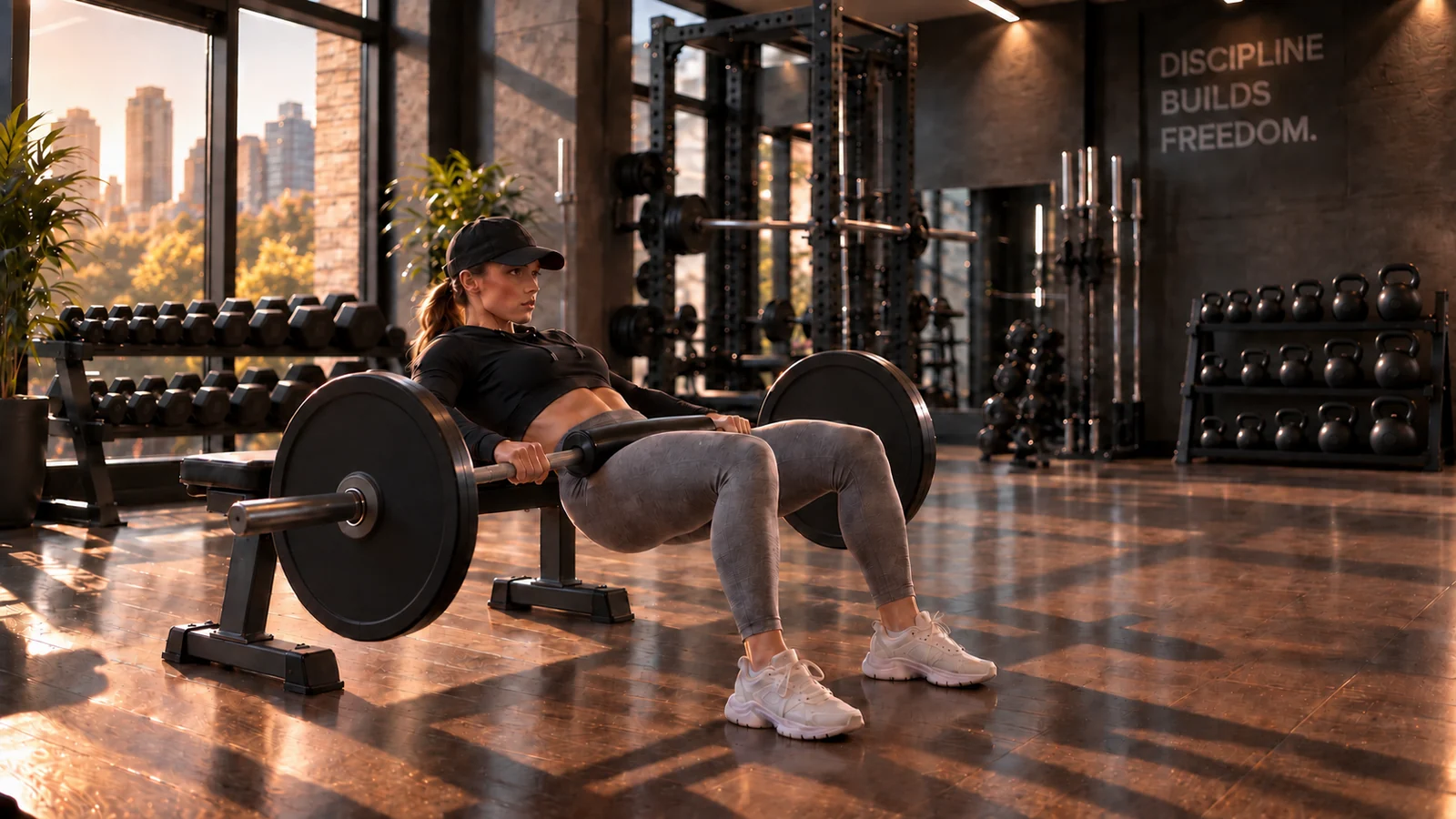
If I had a dollar for every woman who has told me, "I've been squatting three times a week for a year and my glutes haven't changed," I could buy a hip thrust bench for every gym in the country. Here's the thing: squats aren't the villain. They're a great lift, and I program them for plenty of people. But when a squat-only routine isn't building the glutes you want, the problem usually isn't effort. Depending on your build, your depth and how you move, a squat can hand a big share of the work to your quads while your glutes do less than you think. You feel it burning in the front of your thighs, you walk out of the gym like a newborn giraffe, and your glutes quietly get a participation trophy.
Research helps explain why. In a 2015 study, Contreras and colleagues measured muscle activity in trained women doing the barbell back squat and the barbell hip thrust. The hip thrust produced roughly twice the gluteus maximus activity (the electrical signal a working muscle gives off) of the squat, in both the upper and lower parts of the muscle. A 2021 study by Williams and colleagues in the Journal of Strength and Conditioning Research found the same thing: the hip thrust beat both the back squat and the split squat for glute max activation. The reason is mechanical. Your glute max works hardest when it's driving your hips into full extension, the "stand tall and squeeze" position. A squat is hardest at the bottom, when your hips are deeply bent. A hip thrust is hardest right at the top, where your glutes are built to shine.
Now for the part most fitness influencers leave out: activation isn't the same as growth. When Plotkin and colleagues put the two lifts head to head in a 9-week training study (published in Frontiers in Physiology, 2023), the squat group and the hip thrust group grew their glutes by similar amounts, and the squat group also grew more quad and adductor muscle. A 2019 study by Kubo and colleagues found that deep squats grew the glute max more than half squats. So the honest takeaway isn't "squats bad, hip thrusts good." It's that your glutes have several jobs, and a program that trains only one movement pattern leaves results on the table. I think of it like a playlist: your favorite song is great, but nobody wants to hear it on repeat for a year. Your glutes respond the same way. They do best with variety in position and load, as long as that variety follows a plan instead of whatever looked fun on your feed this morning.
That's exactly how the Glute Gains Blueprint is built. Instead of leaning on one favorite lift, the program is organized around three training days, and each one has a different job. One day is about heavy, high-tension work. One is about precision and control. One is about quality volume. Together they load your glutes at the top of the movement, in a deep stretch and on one leg at a time, which covers the jobs a squat alone can't. I won't hand you the full lineup here (that's what the books are for), but I will tell you the principle behind it: no single exercise carries the program. Every movement earns its spot by doing something the others don't. The exercises also stay consistent across all 12 weeks, on purpose. Changing exercises every week feels exciting, but it makes it impossible to tell whether you're actually getting stronger. When the lift you do near the end is the same lift you did on day one, your logbook tells you the truth.
If you love your squats, keep them. Squat as deep as you can while staying in control, and add a hip-extension movement like the Hip Thrust alongside them instead of replacing anything. On that thrust, finish by bringing your hips to neutral, in line with your knees and shoulders, not by arching your lower back to fake a higher lockout. (Your lower back didn't sign up for this, and it will file a complaint.) There's more to a great hip thrust setup than most people realize, from where the bench meets your back to where your feet land and where your eyes point. Get those details right and most women feel their glutes working far more clearly. Book One walks through every one of them, with photos of each position. Start with a weight you can control through the full range. Nobody in the gym is counting your plates, I promise.
Ready to train every job your glutes do? The Glute Gains Blueprint gives you all eight core movements, each with a demo video, a step-by-step setup and a built-in Tempo Coach, laid out across 36 structured workouts. Book One explains why every exercise earns its place, and Book Two teaches you how to actually feel it working. Get the app and both books at glutegainsblueprint.com and start Workout 1 with a plan instead of a guess.
Get the BlueprintSources
- Contreras, B., Vigotsky, A. D., Schoenfeld, B. J., Beardsley, C., & Cronin, J. (2015). A comparison of gluteus maximus, biceps femoris, and vastus lateralis electromyographic activity in the back squat and barbell hip thrust exercises. Journal of Applied Biomechanics, 31(6), 452–458.
- Williams, M. J., Gibson, N. V., Sorbie, G. G., Ugbolue, U. C., Brouner, J., & Easton, C. (2021). Activation of the gluteus maximus during performance of the back squat, split squat, and barbell hip thrust and the relationship with maximal sprinting. Journal of Strength and Conditioning Research, 35(1), 16–24.
- Plotkin, D. L., Rodas, M. A., Vigotsky, A. D., et al. (2023). Hip thrust and back squat training elicit similar gluteus muscle hypertrophy and transfer similarly to the deadlift. Frontiers in Physiology, 14, 1279170.
- Kubo, K., Ikebukuro, T., & Yata, H. (2019). Effects of squat training with different depths on lower limb muscle volumes. European Journal of Applied Physiology, 119, 1933–1942.
Disclaimer: This article is for general educational and informational purposes only and is not medical advice, diagnosis or treatment. Always consult a physician or other qualified healthcare professional before starting any new exercise or training program, especially if you have a medical condition, an injury, or are pregnant or postpartum. Stop exercising and seek medical attention if you experience pain, dizziness, shortness of breath or any other concerning symptoms. Individual results vary.