Stuck? Don't Switch Programs Yet
A slow week isn't a plateau. How to tell the difference before you start over again.
Program-hopping is the fitness version of swiping left. Week 1 of a new plan is exciting. Week 4 is fine. By Week 6 progress slows, someone on Instagram posts a "new booty-building secret," and suddenly you're starting over. Again. I've coached women who went through five programs in a year and ended up exactly where they started, not because any of the programs were bad, but because none of them got enough time to work. Muscle is slow to build. It responds to the same well-planned work repeated over weeks and months, not to whatever is newest.
First, let's reset expectations. Early in a program, progress comes fast because you're learning the movements. Your nervous system is getting better at the skill, so the weights climb quickly. As you gain experience, progress naturally slows down, which is well documented in resistance training research, including the American College of Sports Medicine's position stand on progression (Kraemer & Ratamess, 2004). A slower week isn't a plateau. A plateau is when your performance stalls for several comparable workouts in a row, and even then, it's a signal to check your training, not a reason to throw the plan out. It's also worth knowing that strength and size don't always move together week to week. You might hold the same weight for a while as your control, depth and tempo improve, and that still counts as progress.
Book Two has a six-step plateau check, and the order matters. I'll give you the first two here. Review your technique: is the exercise you're doing on the last rep the same one you did on the first? Protect your tempo: a rushed lowering phase isn't progress just because the weight moved. The remaining four steps cover effort, reps, when to add weight and recovery, and together they catch the real cause almost every time. Nine times out of ten, the "plateau" shows up somewhere in that list. In my experience it's most often an honesty problem with effort, or recovery that quietly slipped. Neither one is a character flaw. They're just the two things that are easiest to fool yourself about, because a set that felt hard and a set that actually was hard can feel exactly the same at the end of a long day. That's why the check works best when you run it against your log instead of your memory.
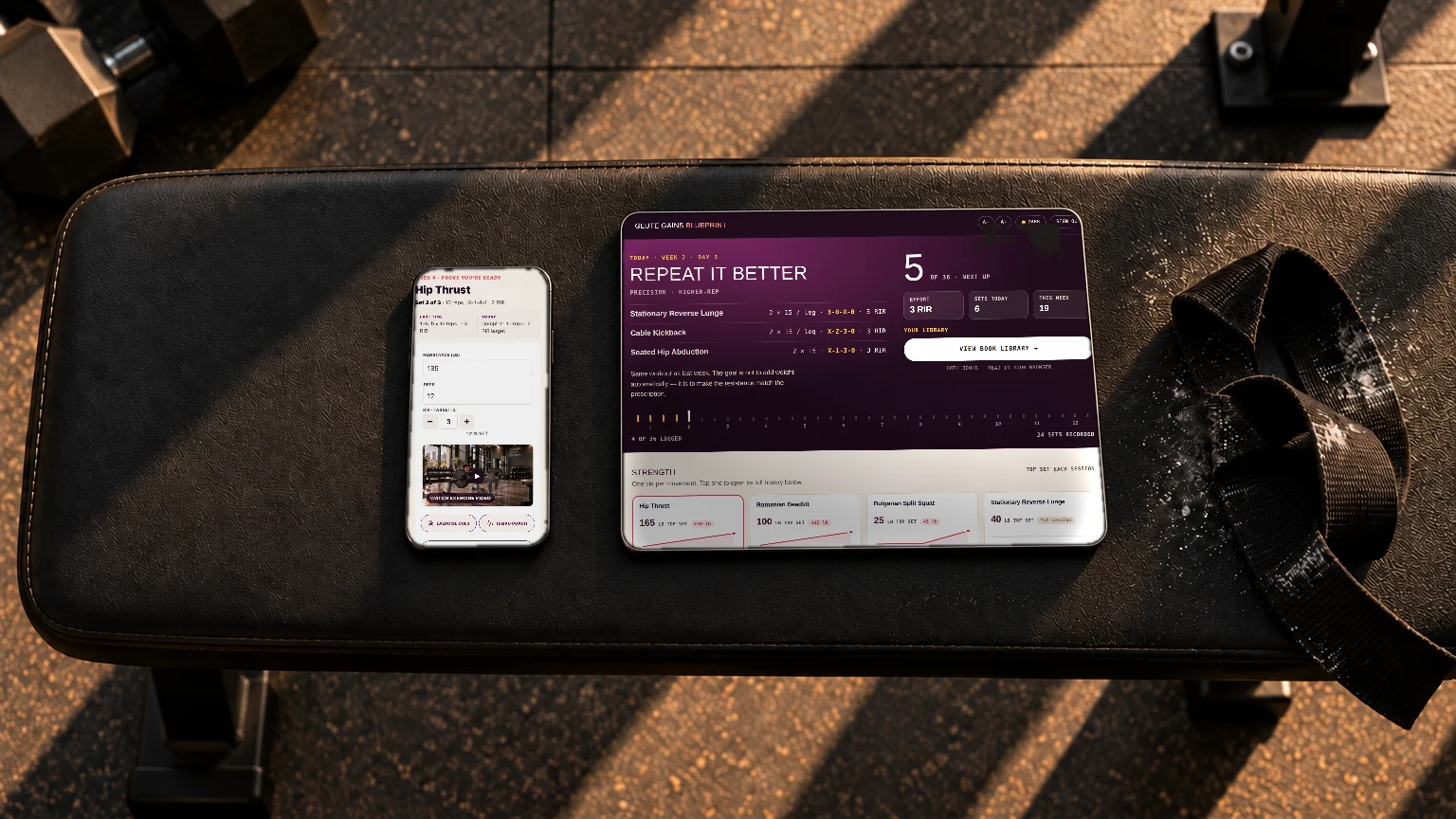
If it doesn't, look outside the gym. The usual suspects are short sleep, not eating enough (especially protein), a stressful stretch at work or home, and gaps in your logbook that make it impossible to tell what actually changed. That last one matters more than people think, and it's why the Blueprint has you log weight, reps and RIR for every set and confirm your technique and tempo after each exercise. When everything is written down, a plateau stops being a mystery and becomes a fact you can fix. A quick tip: before you decide you've plateaued, look back at least three or four comparable workouts in your log. One bad day is noise. Three in a row is a pattern.
And when is it time for something new? At the end of the cycle, not in the middle of it. The Blueprint is a complete 12-week training cycle with a built-in progress check at the end that shows you, honestly, how far you've come. What you learn over those 36 workouts (tempo, effort, earned progression, recovery) is a skill set you keep for your next cycle and every one after it. That's the difference between following a workout and learning how to train. And when you run your second cycle, you won't be starting from zero. You'll be starting from everything you built in the first one.
Break the plateau without breaking the plan. The Glute Gains Blueprint app tracks every set and shows you exactly where things changed, so you can fix the real problem instead of starting over. Book One gives you the progression system and the 12-week progress check, and Book Two walks you through the plateau checklist step by step. Get the app and both books at glutegainsblueprint.com and give your glutes a program worth sticking with.
Get the BlueprintSources
- Kraemer, W. J., & Ratamess, N. A. (2004). Fundamentals of resistance training: progression and exercise prescription. Medicine & Science in Sports & Exercise, 36(4), 674–688.
Disclaimer: This article is for general educational and informational purposes only and is not medical advice, diagnosis or treatment. Always consult a physician or other qualified healthcare professional before starting any new exercise or training program, especially if you have a medical condition, an injury, or are pregnant or postpartum. Stop exercising and seek medical attention if you experience pain, dizziness, shortness of breath or any other concerning symptoms. Individual results vary.