Your Core Is Secretly Running Your Glute Game
When your torso can't hold position, your lower back finishes the rep. Brace — don't suck in.
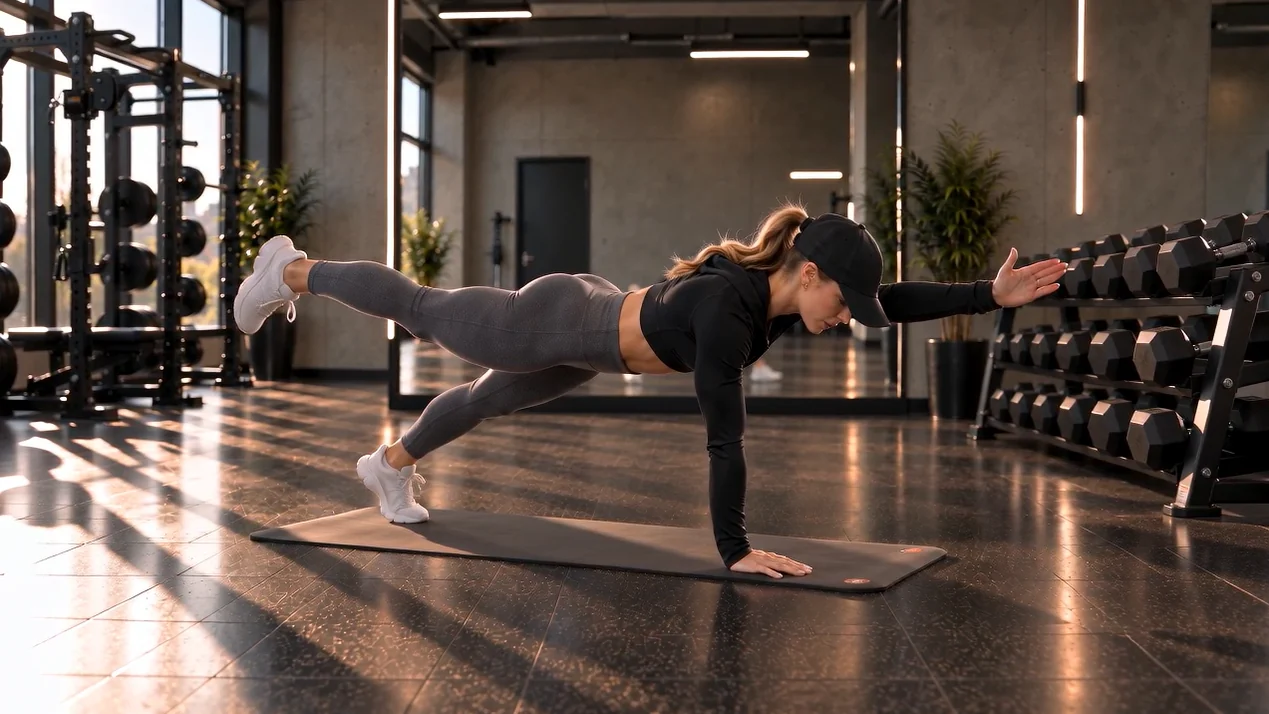
Your core has a bigger job than looking good in a crop top. It's the link between your upper and lower body, and every glute exercise you do goes through it. When your core can't hold your torso and pelvis steady, other muscles step in. Your lower back arches to finish the hip thrust, your quads take over the split squat, and your glutes, the muscle you actually came to train, get to coast. It's a group project where one person does all the work, and unfortunately that person isn't your glutes. This is one of the most common hidden problems I find when a client tells me her glutes "just won't grow." The exercises were fine. Her core just wasn't holding the position long enough for her glutes to get the work.
Research has taken this idea seriously for years. A 2006 review by Kibler, Press and Sciascia in Sports Medicine described core stability as the foundation for making and transferring force to the arms and legs. A 2005 review by Willson and colleagues linked core stability to how well the lower body works and to injury risk. Just as useful is how you engage your core. In a 2007 study, Grenier and McGill compared two approaches: "hollowing" (sucking your belly button toward your spine) and "bracing" (tightening all the muscles around your torso at once). Bracing made the spine considerably more stable. That's why the Blueprint teaches you to brace, not suck in. (Sucking in has its place, mostly in photos. Not under a barbell.)
Bracing sounds simple and turns out to be surprisingly hard to do well. It comes down to where your breath goes, how your abs tighten and how you keep breathing while you hold the tension, and Book One breaks it into a few steps you can practice anywhere. Then comes pelvic position. The most common problem I see is anterior pelvic tilt: the pelvis tips forward and the lower back arches too much, usually from tight hip flexors and weak glutes after long hours of sitting. On a hip thrust, it looks like the classic rib flare, where the lower back arches to create fake height at the top. Finding "neutral" is its own little skill, and once you can feel it, it becomes the starting position for every glute lift you do. Book One includes a simple standing drill to find it, plus a daily rehearsal that trains both skills at once, so they're automatic before you ever pick up a weight.
Book Two also covers a handful of core exercises worth doing as separate core work. My favorite underrated one is the Pallof Press: hold a band or cable at chest height, press it straight out and resist the pull that tries to twist you. That anti-rotation strength is exactly what keeps your hips square during single-leg work, so your working glute does the job instead of your pelvis twisting its way out of it. The others in the book each target a different piece of the puzzle, from keeping your lower back quiet while your arms and legs move to training the side-hip stabilizers that keep you level on one leg. The Blueprint week also has a natural home for this work, so it supports your glute sessions instead of competing with them. Keep this work easy enough that it never leaves you sore for your next glute workout. The goal is a steadier core, not another exhausting session.
When your brace and pelvis are dialed in, everything changes. Clients who used to feel their hip thrusts in their lower back suddenly feel them where they should, and split squats stop feeling like a balancing act. The exercise doesn't change. It just starts working the way it's supposed to. As a bonus, a strong, well-braced core tends to make everyday things like carrying groceries or picking up a toddler feel easier too.
Build the foundation your glutes need. Book One covers bracing and finding a neutral pelvis in "Core Strength & Hip Alignment," and Book Two adds core exercises plus a cue for every glute movement. The Glute Gains Blueprint app puts it all into practice with demo videos and Tempo Coach across 36 workouts. Get the app and both books at glutegainsblueprint.com.
Get the BlueprintSources
- Kibler, W. B., Press, J., & Sciascia, A. (2006). The role of core stability in athletic function. Sports Medicine, 36(3), 189–198.
- Willson, J. D., Dougherty, C. P., Ireland, M. L., & Davis, I. M. (2005). Core stability and its relationship to lower extremity function and injury. Journal of the American Academy of Orthopaedic Surgeons, 13(5), 316–325.
- Grenier, S. G., & McGill, S. M. (2007). Quantification of lumbar stability by using 2 different abdominal activation strategies. Archives of Physical Medicine and Rehabilitation, 88(1), 54–62.
Disclaimer: This article is for general educational and informational purposes only and is not medical advice, diagnosis or treatment. Always consult a physician or other qualified healthcare professional before starting any new exercise or training program, especially if you have a medical condition, an injury, or are pregnant or postpartum. Stop exercising and seek medical attention if you experience pain, dizziness, shortness of breath or any other concerning symptoms. Individual results vary.