Three Muscles, One Booty: Meet Your Glutes
Maximus, medius, minimus. Train one and you build part of the shape. Train all three and the program stops looking random.
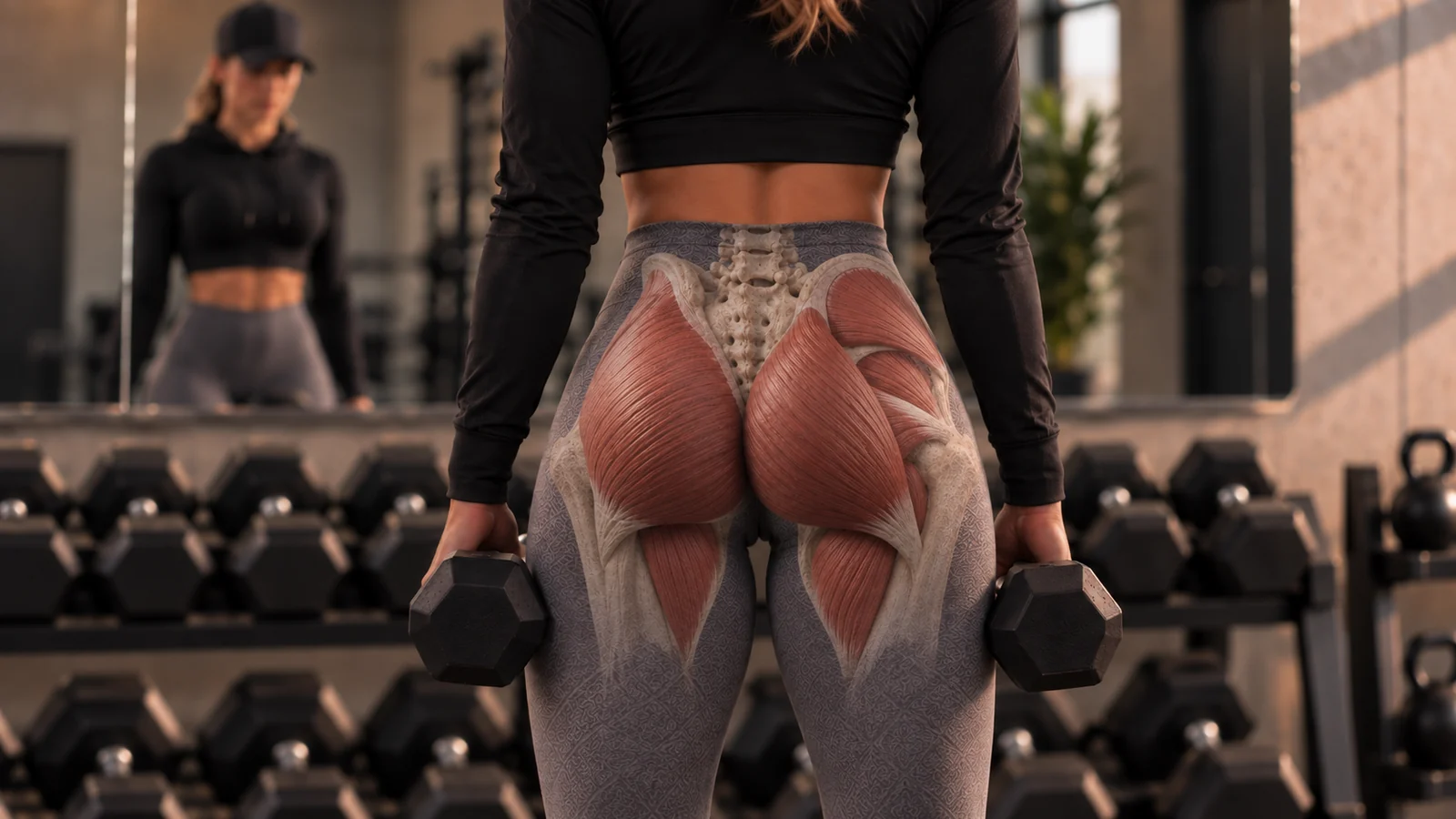
Quick anatomy lesson, and I promise there's no quiz at the end. What most people call "the glutes" is actually three separate muscles on each side, layered on top of each other like a very functional lasagna. If you only train one of them, you'll only build part of the shape you're after. Once you know what each one does, the exercises in a good program stop looking random and start making sense. It also explains why so many women do endless squats and still feel their glutes look "flat on the sides."
The gluteus maximus is the big one. It's the largest muscle in the body and gives your glutes most of their size and roundness. Its main job is hip extension, which means driving your hips forward from a bent position: standing up from a chair, climbing stairs, locking out a hip thrust. It also rotates your thigh outward, and its upper fibers help move your leg out to the side. The gluteus medius sits higher up and toward the side of your hip. It moves your leg out to the side (abduction) and, even more importantly, keeps your pelvis level every time you stand on one leg, which is every single step you take. Well-developed medius muscles also help fill out the upper, outer part of the glutes. The gluteus minimus lies underneath the medius and works mostly as a deep stabilizer for the hip joint. A 2010 review of hip movement by Neumann in the Journal of Orthopaedic & Sports Physical Therapy is a great deep dive into how these muscles share the work. Here's an easy way to feel your medius right now: stand on one leg and notice the side of your standing hip tighten to keep your pelvis from dropping. That's your gluteus medius on the job, and it does that thousands of times a day.
Different exercises favor different muscles. In a 2009 study in the same journal, Distefano and colleagues measured glute activity across common exercises. Side-lying hip abduction produced the highest gluteus medius activity, while single-leg movements such as the single-leg squat and single-leg deadlift scored high for both the medius and the maximus. A 2012 review by Reiman, Bolgla and Loudon reached similar conclusions across many studies. Single-leg work challenges both size and stability at once, which is one reason it earns such a big role in a smart glute program. It's also why the Blueprint trains single-leg work one side at a time, finishing all reps on one leg before switching. That keeps tension on the working side and stops your stronger leg from quietly covering for the weaker one.
The Blueprint is built to cover all three. Some of its movements focus on the maximus through hip extension, loading it at the top of the movement or in a deep stretch. Some work one leg at a time, so the maximus drives the rep while the medius and minimus fight to keep your pelvis level. And a couple target the medius and minimus directly. Spread across the training week, that trains every job your glutes have, through different positions and rep targets. Book One has a full breakdown of which exercise does which job, and once you see it laid out, the whole program makes sense. Nothing is in the program because it's trendy. If an exercise doesn't have a clear job, it doesn't get a spot.
One honest note, because you deserve it: part of your glute shape is set by things training can't change, like your pelvis structure and where your body tends to store fat. No program can give you a different skeleton, and anyone who promises that is selling something. What training can change is the muscle itself, and building all three glutes is how you get the most out of the frame you've got. Everyone's result looks different, and that's the point. It's yours. In my coaching, the women who are happiest at the end of a program are the ones who focused on getting stronger and moving better, and let the shape follow.
Train all three, not just the famous one. The Glute Gains Blueprint app gives you all eight core movements with demo videos, setup steps and Tempo Coach, arranged so every glute muscle gets trained every week. Book One breaks down which exercise does what, and Book Two teaches you to feel each muscle working. Get the complete system at glutegainsblueprint.com.
Get the BlueprintSources
- Neumann, D. A. (2010). Kinesiology of the hip: a focus on muscular actions. Journal of Orthopaedic & Sports Physical Therapy, 40(2), 82–94.
- Distefano, L. J., Blackburn, J. T., Marshall, S. W., & Padua, D. A. (2009). Gluteal muscle activation during common therapeutic exercises. Journal of Orthopaedic & Sports Physical Therapy, 39(7), 532–540.
- Reiman, M. P., Bolgla, L. A., & Loudon, J. K. (2012). A literature review of studies evaluating gluteus maximus and gluteus medius activation during rehabilitation exercises. Physiotherapy Theory and Practice, 28(4), 257–268.
Disclaimer: This article is for general educational and informational purposes only and is not medical advice, diagnosis or treatment. Always consult a physician or other qualified healthcare professional before starting any new exercise or training program, especially if you have a medical condition, an injury, or are pregnant or postpartum. Stop exercising and seek medical attention if you experience pain, dizziness, shortness of breath or any other concerning symptoms. Individual results vary.